
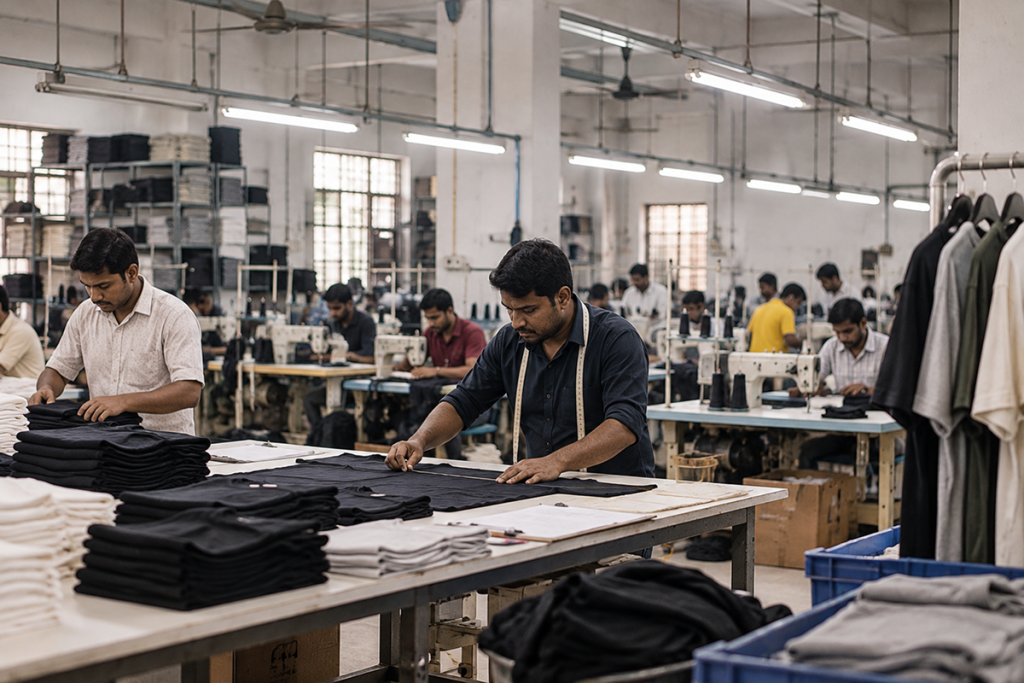
Large-Scale Apparel Production in India has become an important part of the global clothing industry. India is one of the world’s largest clothing production centers and an excellent place to invest, though scaling projects demands elaborate planning. Cooperation with India’s most successful textile regions may be highly profitable for your business, but it requires careful consideration.
Identifying the Best Regional Textile Hubs
Tirupur and Ahmedabad are two of the biggest centres of the Indian garment industry, and each offers something different:
- Tirupur: Known for strong bulk manufacturing capacity and a large pool of skilled labour.
- Ahmedabad: Sits close to raw material sources and lead times.
Being close to cotton farms ensures the production timeline is maintained.
Streamlining the Supply Chain
One must always ensure close connections with suppliers handling the large flow of goods. If any zipper or button is late, the production process will be delayed. Communication is achieving this, and online tools and shipments enable companies to spot delays.
Setting Up Strong Quality Control
Small errors add up fast when you’re producing thousands of units. Below are two key concepts that should receive special attention: implementing quality checks at various points in the cutting and sewing processes and hiring independent inspectors to oversee the implementation site. Together, these two measures safeguard your brand and keep customers happy without being at the production site.
Balancing Cost and Output
- In general, larger orders lead to lower prices from factories.
- Buying in bulk means that the cost per item is lower.
- You can always allocate extra money saved from production costs to other areas, such as the marketing department.
- Don’t forget to keep an eye on inventory; producing too much stock can result in dead stock that costs.
- Hence, a leaner approach can ensure flexibility in terms of changing demand.
Staying Compliant, Legally and Ethically
Customers are becoming increasingly aware of their clothing. There are a couple of approaches to this: the law and ethical sourcing. Legal compliance means examining the production site to determine whether it meets local labor and safety regulations. Ethical sourcing means obtaining certifications, such as GOTS or Fair Trade, to show that the company cares about the.
Managing International Logistics
It is essential to be aware of freight and customs regulations when shipping large containers overseas. A logistics company in this area can assist you with the documentation process, and everything goes smoothly. It is advisable to calculate your shipping costs beforehand, preferably during the design phase, surprises. It is advisable to calculate your shipping costs beforehand, preferably during the design phase, unpleasant surprises.
Using Technology to Track Production
- Cloud-based tools let you track production in real time, showing exactly how many units a factory has completed on a given day.
- Predictive tools can catch bottlenecks before they cause delays.
- Together, these give you an edge over brands still relying on manual tracking and paper records.
Understanding Cultural Context
In India, strong and successful partnership building with manufacturers requires time and respect. Visiting factories in person, when possible, builds up trust in a way email communication alone cannot. Additionally, it is good to know the local holiday schedules in advance so you do not stop production unexpectedly.
Choosing Reliable Manufacturing Partners
Finding the right factory takes real research. Look for a proven track record in export-quality production, and check references carefully before signing any long-term contract.
| Feature | Importance | Target Metric |
| Factory capacity | High | 50,000+ units monthly |
| Lead time | Medium | 45 to 60 days |
| Compliance | Critical | ISO/WRAP certified |
Conclusion
Choosing the right manufacturing hubs, building multiple supplier relationships, and closely monitoring quality can enable organizations to scale up their apparel production in India. Ethical production rules and proper utilization of tracking technologies are vital to ensure that the company’s assets remain protected.
In this case, cultural complexity and modern logistics were recognized as the main advantages for new and developing companies to build their distribution in the region. Therefore, a company can take these opportunities to gain competitive advantages and consider expanding its business.