
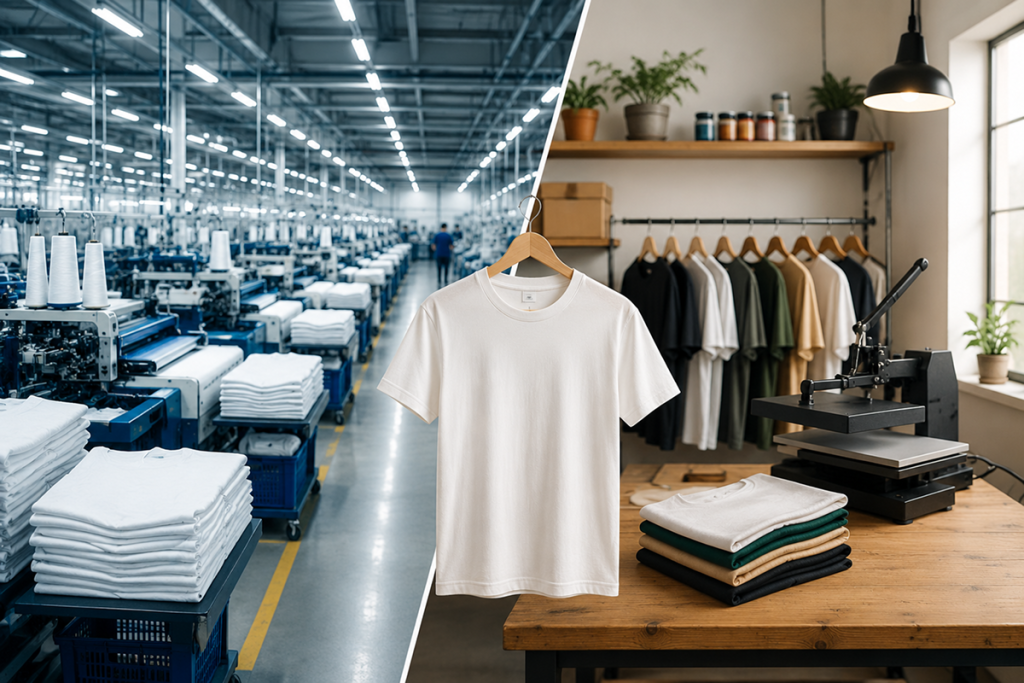
Factory-Level Manufacturing vs Local Production is one of the most important decisions you’ll make when starting a new T-shirt brand or expanding an existing one. The manufacturing method you choose directly impacts product quality, production costs, scalability, turnaround times, customization, and your overall brand reputation. While local production may seem convenient for smaller orders, factory-level manufacturing offers advantages for brands looking to grow consistently. Understanding the differences between these two approaches will help you choose the right production model for your business.
Factory-Level Manufacturing vs Local Production: Key Differences
Choosing between these two manufacturing methods isn’t always straightforward. While factory-level manufacturing is ideal for brands looking to scale, local production offers flexibility for smaller businesses. Understanding both options will help you make the right decision based on your production goals and long-term growth.
Understanding Factory-Level Manufacturing
How Factory Manufacturing Works for T-Shirts: For a business manufacturing their T-shirts at factory level, this usually means having high-volume production plants that have industrial equipment, trained labor, and a very smooth production process. This equipment allows them to manufacture thousands of items in a relatively short timeframe. If you are a T-shirt company that is scaling up and has a great demand for your shirts, working with a factory allows you to tap into a professional system that often deals with major brand names and also allows access to a bulk purchase of materials.
Benefits of Factory-Level Production
Reduced costs: A key benefit of factory production is the efficiency gains it allows for. Because garments are produced at scale, individual costs are minimized for businesses, ultimately increasing profits or reducing consumer prices. Quality Control: Factory production also allows for an increase in quality control. Processes such as standardized printing, assembly line production, and skilled technicians allow brands to ensure each garment produced is the same, with the right dimensions, finish, and style each time which can be vital for companies with brand integrity in mind.
Limitations of Factory Manufacturing
However, factory-level production may not be the best for every T-shirt brand. Major factories tend to have a minimum order amount (MOQ), which can be an issue for startups and new designers trying out their concepts. Additionally, it can also lead to communication problems, especially if you are working with an international manufacturer. Issues with different time zones, quality of work, or production time expectations need to be ironed out to a great degree.
Understanding Local Production
It involves manufacturing t-shirts in the same area or country where your brand is based. Local manufacturers are smaller workshops, freelance makers, or a local printing company. They tend to enable brands to have stronger relationships with production partners and have more control over production processes. It’s a choice common for smaller brands, brands with a strong focus on ethics, or with an interest in community-based businesses.
Benefits of Local Production
The main benefit of local manufacturing: agility. Businesses can make smaller batches, experiment with new designs, and adapt to feedback from the market almost instantly. This flexibility is essential to young brands exploring their identity. Local manufacturing also makes communication and quality control easier, because your team can tour the facility, check the samples firsthand, and build a relationship with the manufacturer. If your customers are sustainability-conscious, locally manufactured tees also offer more of a story for customers.
Which Option Is Better for Your T-Shirt Brand?
The choice depends on your current business stage and what you’re aiming for. If you need to produce large batches, at cheaper production costs, and with assured quality output, then a factory run might be more appropriate for your brand. If your brand is more mature, has stable demands, and requires consistent and significant orders, a factory run will make more sense.If you are, on the other hand, releasing your new line of designs, experimenting on what might sell well, or going for the limited run/ boutique look, you may benefit from going the local route. In fact, many profitable t-shirt brands make use of both factories and local manufacturers. Some even go for local manufacturing first to test the ground before they expand to larger orders from a factory, as they grow and their demands increase.
Conclusion
The Factory or the local one it’s all your call, the manufacturing and the local has its advantages – as a matter of fact some benefits can be gained on both sides one ensures the benefits of manufacturing efficiency, cost reduction as well as economies of scale, where on the other hand you get flexibility and closer quality assurance, you are also better in touch with your customers in a more personal way – there is more in it, and you are most welcomed to choose your style on the base of the size and aims of your Brand, as well as the budget you want to put in it.