
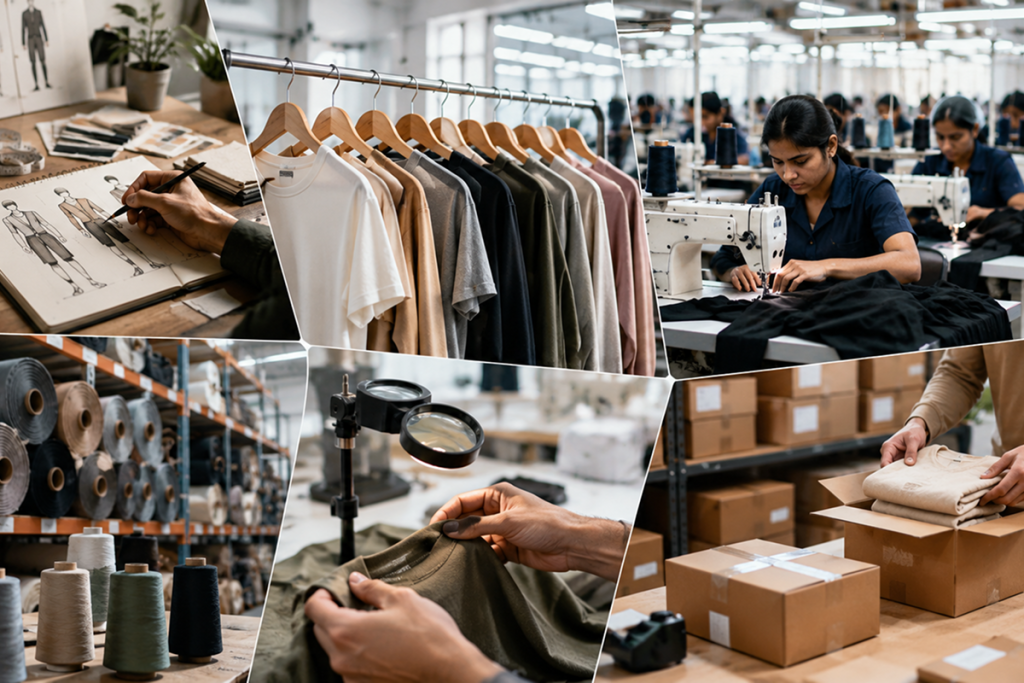
How to Build a Scalable Clothing Brand with Factory-Level Manufacturing? You can build a scalable brand for clothing by making sure you choose the right fabric, the right design and the most in-demand pieces that have reasonable prices, but there is a lot more to understand. Let’s explain them over here one by one:
Firstly, Align Your Budget
Most people who plan to enter clothing manufacturing often neglect the most important factor: aligning the budget properly. The clothing industry has one of the biggest levels of competition, and unless your budget is planned strategically, it becomes difficult to build a successful and scalable clothing brand.
Common Mistakes that People Make People Making When Starting a Clothing Brand
One of the most common mistakes people make is starting with simple reselling. They buy products from wholesalers and start selling them online. The problem with this approach is that there are already hundreds of people selling the exact same products. While the initial investment is lower, the marketing cost becomes much higher because you are competing with too many similar brands in the market.
To avoid this issue, we always suggest going for private labelling instead of basic reselling. Yes, the initial investment in private labelling is slightly higher, but it gives you something much more valuable: your own brand identity. You introduce a new theme, a different voice, and a unique style that people can connect with.
Rastah Case Studies
Take the example of Rastah. The brand was founded in 2018, but what made it stand out globally was not just the clothing, it was the storytelling, cultural identity, and completely different approach. That unique positioning became the reason behind its success.
Budget Alignment and Micro Niche
Now comes the most important part: budget alignment. Instead of targeting a broad market in the beginning, choose a micro niche. This allows you to enter the market with less competition and more focused branding. For example, instead of creating a general streetwear brand, you can target:
- Vintage oversized tees
- Anime-inspired hoodies
- Gym pump covers
- Minimal luxury basics
- Pakistani culture-based streetwear
A micro niche reduces unnecessary manufacturing costs because you focus on fewer designs and more targeted inventory. It also makes marketing cheaper since your audience is already defined.
For example:
- Reselling startup budget: around $800–$1,500
- Private label micro niche brand: around $2,500–$5,000 initially
But here is the difference:
- In reselling, most of the budget later goes into paid marketing because there is no uniqueness.
- In private labelling, the product itself becomes the marketing because people remember the brand identity.
A smart approach is to spend more on three things:
- Good-quality fabric
- Strong brand identity
- A reliable manufacturer from cost-effective regions like India or Pakistan
If your niche is focused and your manufacturing is controlled properly, your overall scaling cost becomes much lower compared to building a macro clothing brand from day one. That is why brands that start small, targeted, and unique usually survive longer in the fashion industry.
Secondly, Find a Right Manufacturer
The right manufacturer does not mean a manufacturer that shows you only the bright side and sells you what he wants to sell. The Right manufacturer will share the insights of the market, will suggest the products to you, and will tell you its drawbacks as well. The right manufacturer will help you find the budget-friendly options with good design as well. Here are a few points to consider when choosing the clothing brand manufacturer:
- Make sure they deliver worldwide
- They should have factory-level MOQs
- A good manufacturer should have at least 5 variations of fabric types
- They should provide branding, packaging, labelling, and worldwide delivery
We have seen many people getting misguided by manufacturers, and they now have 1000s of pieces in stock that are of no use because the quality is also compromised.
Thirdly, Focus on Product Quality and Quantity
You should choose the manufacturer that provides variations in fabric, no matter if it is a female brand or a male-oriented manufacturing. For example, even if it is cotton, Alphastyle is selling
- Pure Cotton Looper
- Pure Cotton Sinker
- Pure Cotton Tensile
- Laycra Cotton
This gives you the independence to choose the right fabric that suits your region, climate and the choices of people. Similarly, many manufacturers only take orders when you order in bulk, and they do not offer MOQs. A good manufacturer should provide at least factory-level MOQs.
Fourth, Designing is Important
No matter how good your fabric quality is, if the designs are not pretty, you won’t be able to sell properly. It should be minimal design but pretty. Now, most people, and especially your new consumers who are Gen Z and Gen Alpha, prioritise the stuff, the quality and then minimal designs. Neither too fancy nor too flashy. They also do not like the shirts with too much brand advertisement, like where there used to be written Adidas and Deluxe in bold.
Case Studies Related to Designs:
Brands like Abercrombie & Fitch successfully revived their market by moving away from loud logo-heavy fashion toward cleaner and more wearable designs preferred by Gen Z.
A 2025 study called “Exploring minimalist fashion drivers for Gen Z” found that younger consumers are heavily attracted toward:
- intentional fashion
- simple aesthetics
- sustainability
- self-expression without excess
The study explains that Gen Z’s idea of minimalism is not “boring fashion,” but fashion that feels authentic and aesthetically balanced.
A 2024 research paper studied how minimalist branding affects Gen Z buying behavior.
It found that:
- cleaner logos improve brand perception
- minimalist visuals increase purchase intention
- younger consumers associate minimal branding
This often leads to organic growth of the brand, and selling becomes easier. a
Fifth, Marketing and Selling
If your brand is already unique and it has a reasonable identity, your marketing costs will be less because your organic traffic on social platforms will help you achieve good sales. Then you would only need to make good visual ads, work on good videos and you are all set on sales. Recent menswear case studies from brands like Percival, Levi’s, Gap, and Marks & Spencer show that modern consumers are more influenced by visual content and brand identity than traditional promotional advertising.
Sixth, Find All Alternatives Like Resellers, Small Businesses, and Home-Based Sellers
Now, do not depend only on the marketing and these platforms. Before launching the brand, look for resellers and small businesses who will be willing to sell your product but with your own name.
Some of the biggest examples are:
- Zalando
- ASOS Marketplace
- Farfetch
- ABOUT YOU
- YOOX
- Boozt
- Macy’s Marketplace
- Nordstrom Marketplace
They allow the brands to sell their products under their own identity, packaging and labelling. In this way, you will have multiple channels to grow.
Seventh, Reorder the One That is Most in Demand
Stay in touch with your manufacturer and re-order the most in-demand options. This will help you to stay in the loop and keep giving your consumers what they need!
If you want a good manufacturer from India for men wear, contact us anytime!