
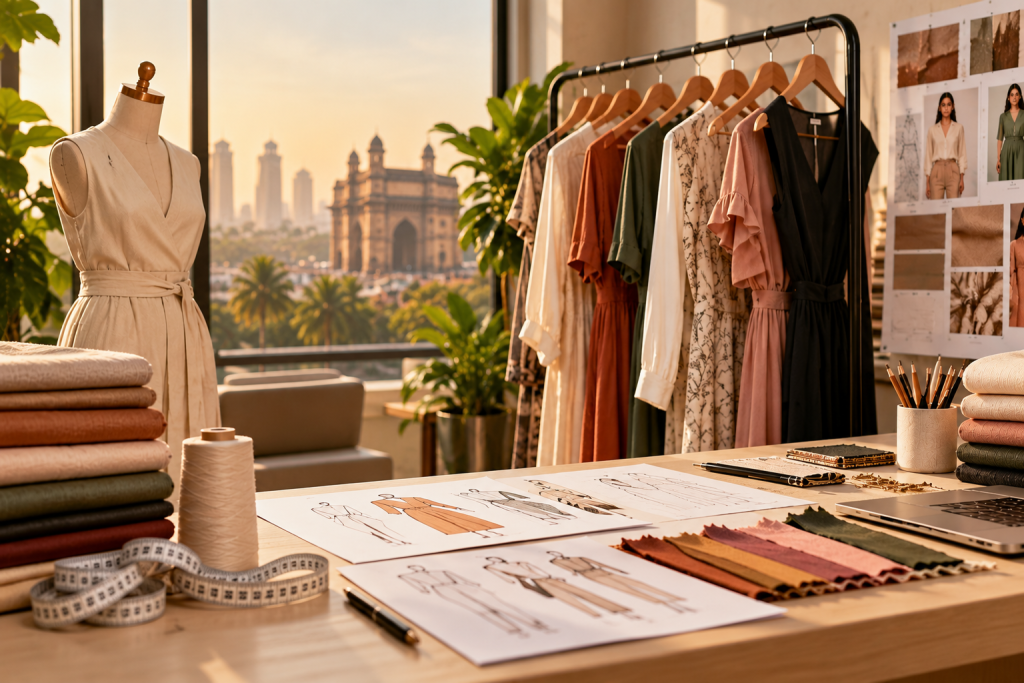
With affordable premium fashion in India evolving into a major focus for retailers, brands are aiming to provide customers with better-quality apparel without moving into the luxury price segment. Customers expect well-made garments, appealing designs, suitable materials, and excellent finishing for the price they pay.
Fashion brands select fabrics and construct garments for retail sale and build sample garments to show to distributors, retailers or to display on their websites. Then, based on their target pricing for retail sale, brands determine how many items to produce and at what manufacturing cost.
Right clothing manufacturer in India: There are many textile suppliers, garment manufacturers, embroidery service providers and private-label production companies in India who can provide excellent clothing manufacturing services to fashion brands. However, finding right production partner in India is not easy. They need to understand brand’s target audience, brand’s quality parameters and brand’s price parameters.
Here is what businesses should know before starting affordable premium fashion production in India.
What Is Affordable Premium Fashion?
There is a huge potential in clothes that can be bought by customers in affordable premium segment. This apparel is more than just basic mass market clothing yet it is not expensive high-end designer garments. It has better fabrics, good design, good construction and good finishing all put together at reasonable prices for customers to purchase and wear.
The affordable premium category is primarily comprised of products such as premium cotton kurtas, coordinating sets, embroidered dresses, stylish and trendy ethnic wear, casual daily wear and premium private-label clothing.
For a clothing brand, creating premium fashion does not necessarily mean to use expensive fabric or many decorations. A garment that is perfectly fitted, is made with good stitchings, has the right fabric and has the right sizes, can give more value than a garb with many decorations and bad construction.
The focus is to create clothing that looks and feels to be of superior quality whilst still adhering to a budget and ensuring production costs are kept to a minimum.
Why Brands Source Premium Clothing From India
The Indian textile and apparel industry is well established to support brands that are looking for sourcing fabrics, trims, printings and embroidery as well as complete garments from different manufacturing sets up.
Therefore, India is an excellent sourcing destination for affordable premium clothing collections ranging from traditional outfits to more contemporary offerings.
Key advantages include:
- Fabric choices: Cotton, viscose, linen blends, and other materials suited to different product categories.
- Traditional craftsmanship: Embroidery, block printing and many more other techniques can be executed perfectly within the textile arena of India.
- Product Variety: Include various products like women’s wear, men’s wear, ethnic wear, casual wear, formal wear and occasion wear.
- Private-label production: Manufacturers can also produce garments under a brand’s own label, provided the manufacturer has the capability to produce under private label.
It is, however, important to note that the advantages stated above do not translate into lower or better quality goods for every supplier. The actual manufacturing capability, location, order quantity, fabrics sourced, and production parameters all have a role to play.
1. Choose Fabrics Based on Your Target Price
Fabric is the first element to choose to determine the cost of your apparel as well as the quality of your products.
Material for affordable premium clothing has to support the brand’s concept and satisfy customer’s requirements. Its quality has to be appropriate for everyday wear, washes and use.
Fabrics like cotton can be ideal for products such as everyday kurtas and casual shirts, whereas viscose blends could be ideal for fabrics that have a fluid quality to them such as dresses and coordinated sets. A linen blend could be perfect for a light, summer collection.
Before approving a fabric, consider:
- Fabric composition and weight
- Texture and drape
- Shrinkage after washing
- Colourfastness
- Durability
- Availability for repeat orders
- Cost per garment
Check if your manufacturer can provide you with fabric samples before committing to a bulk order of fabrics. Test for shrinkage, check for colorfastness where relevant and ask for specifications for other performance characteristics of the fabric.
Keep in mind that the lowest cost material may have several negative effects on your products, customer satisfaction and your future orders.
2. Understand the Cost of Garment Construction
The cost to make two garments made from similar fabrics can be very different.
A simple kurta would need a different amount of time and labor for completion than a garment with multiple panels, lots of embroidery, ties at back and lining etc.
The main cost factors include:
- Fabric consumption
- Pattern development
- Cutting and stitching
- Embroidery or printing
- Buttons, zippers, and other trims
- Washing and finishing
- Labels and packaging
- Quality inspection
Brands should provide sufficient information to manufacturers when requesting quotations for garment production. Brands should provide manufacturers with product information, i.e. product measurements, fabric details, design information, color options, embellishment information, packaging information and other relevant information.
This ensures manufacturers are quoting for the actual product you wish to have produced not an estimate that could change when production starts.
3. Develop Samples Before Placing a Bulk Order
Sampling is one of the most useful steps in clothing production.
A sample allows your team to check and verify all aspects of the garment such as design, fabric, fit, workmanship and finish before placing a large order for production.
Document all of the approved specifications for production. Keep approved samples where they can be referred to by the production team.
Remember that although it may cost very little, the sample must reproduce what the manufacturer can be expected to produce on a larger scale.
4. Understand Minimum Order Quantities
Minimum order quantity (MOQ) refers to the minimum amount of a product that a manufacturer will agree to produce for an order.
The MOQs of suppliers differ greatly. They are not only depending on the article to be produced but also on the kind of garment, the fabric, the degree of product individualization and the kind of customization.
A manufacturer may have different minimums for a manufacturer-ready design, printed products or a fully customized private-label collection. Although all products may be part of the same production run, they are different production situations and therefore one minimum order quantity does not apply to all products.
Before confirming an order, ask:
- What is the minimum quantity per design?
- Does the minimum quantity apply for every color or does it apply for the total order and can you mix sizes in the order?
- Can sizes be mixed within the order?
- What are the implications if the fabric supplier has larger minimums than you?
- Are repeat orders subject to the same minimums?
Relying on an apparently lower price for larger orders could leave a business locked into large amounts of stock and blocked working capital, losing money whilst it tries to sell the goods.
This then needs to be compared to the savings per unit of purchasing a larger quantity for a new collection and weighed up against the risk of holding inventory that is not going to sell.
5. Build a Realistic Production Budget
A manufacturer’s quotation for garments can sometimes include elements of cost that a business has not taken into account for ordering ready-to-sell clothing.
Businesses need to calculate the complete landed cost to their country for importing ready made products from India.
All costs do not necessarily apply to every order. The above costs are based on the information provided in this web page and may vary based on terms of trade (such as FOB), the country of destination, the classification of goods (e.g. textiles), etc.
Ask the manufacturer who is responsible for any of the services listed above and what cost they will incur.
Then you have to calculate the landed cost per sold article in order to calculate the right wholesale prices and retail prices and also the right margins.
6. Consider Private-Label Clothing Manufacturing
Private-label production allows your business to sell clothing produced by another supplier under your own brand name.
A private-label production line can be an excellent option for boutiques, online shops and established fashion labels that want to produce their own garments without having to set up their own factory.
A range of services can be provided such as design, fabric selection, garment measurement, production of woven labels, printed labels, hangtags and packaging in the manufacturer’s branded company names.
Who owns the design? Can the manufacturer then sell the same design to other customers? Who is responsible for ensuring that approved specifications have been met? (Put all of these in writing and endeavor to ensure that sufficient confidentiality arrangements are in place).
Can the supplier deliver the same quality and measurement standards when re-ordering.
If a brand manufactures products under a private-label agreement, they should make sure they have specified the required product characteristics (quality, measurements, etc.) and that the manufacturer is able to provide them with the desired goods within the agreed time frame and at the correct price.
7. Set Quality Standards Before Production Starts
Quality control should not begin only when the finished garments are ready to ship.
Brands should agree on acceptable standards during product development.
Document all relevant specifications (such as the mentioned fiber mix, measurements, stitching, colors, additional trimmings, labels and packaging) on a list (specification sheet).
Inspections at suitable production stages will highlight any fabric problems, incorrect measurement, or deficient stitching prior to completion of the full order.
How would the manufacturer treat defective products and how would they be recorded? How would the manufacturer treat finished products that do not comply with the approved specification?
Clear written standards for what you consider to be acceptable help to prevent misunderstandings and provide a reference point for both parties.
8. Check the Manufacturer’s Production Capacity
Many suppliers will do great samples, but not be able to fulfill large orders on time. It’s also very important to determine a supplier’s current production capacity vs. what they can realistically do in a certain time frame.
Ask the manufacturer about their current capacity, lead time, raw material availability, quality control process etc. Also, find out about their previous experience with similar products.
Also it is a good idea to confirm a production schedule which covers sampling, procurement of materials, mass production, quality check and dispatch.
The launch date must include time for sample revision if required, and for any unexpected production delays. You should not rely on an informal delivery estimate when setting a launch date for a seasonal collection.
Ensure that export documents and shipping arrangements are made by the supplier in the case of international orders. Clearly outline both parties’ roles in the agreement.
How AlphaStyle Can Support Your Clothing Production
Choosing a good manufacturer is a commercial decision. You need someone who understands the sort of garments you are trying to sell, the sort of quality your customers expect, and the sort of price you are trying to achieve.
Here at AlphaStyle we work with a variety of different businesses that are looking to source quality made clothing in India to sell Wholesale or under a Private Label.
The key details to consider will help you identify whether your proposed order is viable and whether any changes are required to ensure that it meets your affordable premium fashion budget.
Start Your Affordable Premium Fashion Collection in India
Affordable premium fashion is all about finding the right balance of quality and cost for your garments. It requires some key considerations around fabrics, garment construction, quantity, samples and quality control.
India offers many options for apparel manufacturing to fashion brands worldwide. The most important factor is to select the appropriate supplier for your specific needs.
A representative sample of the goods to be supplied should be approved by you prior to a placing of a large order. Product specifications, landed cost and terms and conditions for delivery should also be clarified.
Looking for an Indian clothing manufacturer for bulk or private-label orders? Contact Alpha Style to discuss your collection requirements, production quantities and product specifications.